

Photographs

There is something about photographs that only reveals itself when you are sitting in the middle of them, not just looking, but feeling them, and that is exactly where we found ourselves one evening right after my mom passed. The plan was simple, gather photos for her services, choose a few meaningful ones, and move forward. At the same time, my daughter was also looking for photos for her wedding tables, wanting to bring pieces of her childhood into a new beginning. What we did not expect was how quickly the evening would shift from a memorial task into something much deeper.
Three large storage containers were pulled out, filled with albums, loose photos, negatives, and decades of life. What started as sorting became hours of sitting together, laughing, smiling, and remembering. Each photograph held more than an image, it held a moment, a version of people and places that no longer exist in quite the same way. The room filled with stories that had been tucked away, and for a while, time felt less linear, as if the past and present were sitting side by side.
Photographs have a quiet way of holding on to what life changes. They preserve people as they were, places as they felt, and relationships in the seasons they existed. Even when families shift, whether through loss, distance, or divorce, those images remain steady. They tell a truth that is easy to forget in the middle of change, that love existed, that it shaped what came after, and that it does not simply disappear because life looks different now. Children are still made from that love, connected to it, even when its form has changed.
There is also something to be said about the person behind the camera, the one who is often missing from the frame, and in this case, that person was most often me. I was the one trying to record it all, to hold onto it in real time, to make sure that nothing slipped by unnoticed. So many parents spend years capturing everything, every angle, every milestone, every ordinary day that somehow feels worth saving, and I was no different. If anything, I leaned all the way in. My kids will tell you that I was always stopping, always turning back, always saying, “wait, just one more,” because I saw something I didn’t want to lose. There were plenty of groans, plenty of “oh mom… not again,” and more than a few dramatic sighs, but they also learned quickly that the faster they cooperated, the sooner it was over. It became our rhythm, my insistence on capturing the moment, and their reluctant, but very practiced, compliance.
It is easy to overlook that those photographs were never random. They were not just moments I happened to catch. They were intentional acts of noticing. I was paying attention, watching the small shifts, the quiet growth, the details that might otherwise be forgotten. I saw the moments as they were happening and, even then, I understood that they would not remain in that way ever again, so I did the only thing I knew how to do. I tried to keep them, the best way I could.
Photographs reflect that kind of seeing. They show smiles changing over time, hands growing steadier, rooms that once felt full, and ordinary days that, in hindsight, held more meaning than anyone realized at the time. They capture the in-between moments, before childhood gives way to independence, before voices deepen, before homes feel different, before time rearranges everything in ways no one can fully anticipate or comprehend.
In that way, photographs are not just records of what happened, they are evidence that it mattered. They hold onto the versions of people that existed in a specific moment, the ones that may not live in memory as clearly as we would like. They allow us to return, even briefly, to a time and place that we would otherwise continue to move further away from.
Sitting in that room, with one generation being remembered and another preparing to begin something new, it became clear that this is what photographs do. They bridge what was with what is coming next. They carry love forward, not perfectly, not without change, but faithfully.
And the truth is, I am still doing it. I am still stopping along the way, still turning back, still trying to catch the light just right before it disappears, convincing myself that this sunrise or that sunset simply cannot be missed before the day begins or ends. I am still capturing the moments, especially the ordinary ones that do not feel like anything special until they are gone, trying in my own way to hold onto them just a little longer, to keep them somewhere safe. If my camera roll is any indication, along with the millions of photos living on my phone and floating somewhere in a cloud I am not sure I fully trust or entirely understand, I have not slowed down. And yes, there are probably twelve nearly identical versions of the same sky, because clearly each one felt necessary at the time. Because even now, I know what I knew then, that these moments will not last.
And one day, when those photographs are held again, whether for a service, a wedding, or simply a quiet moment of reflection, the hope is that they are seen for what they truly are. Not just images, but reminders that people, especially my children, were deeply known, fully loved, and carefully noticed, even on the most ordinary days doing the most ordinary tasks. Because in the end, photographs are one of the ways we hold on, not just to what was, but to what mattered most.

Peace,
#tutulady
#forwardisapace
Outside

I try to get outside every single day. To walk, to run, to move my body in some way, even when the weather is doing everything it can to convince me otherwise. Extreme heat, biting cold, wind that feels personal, humidity that is oppressive, it does not always make it easy, but I go anyway. Some days it is a long walk, some days it is shorter, and lately, if I am being honest, there is more walking than running as my body gently reminds me that I am not in my 50s anymore. And that is fine. I am still moving. I am still showing up.
People often ask why I am so consistent about it, and the answer is actually pretty simple. When I am outside, I am not distracted. Most days I do not listen to music, I am not on a call, and I am not catching up on a podcast or a book. I am just there, listening to the world. The birds, the cars passing by, kids playing somewhere in the distance, the ordinary sounds of a neighborhood going about its day. There is something grounding about it, something that pulls me out of my own head and places me back into the present.
Being outside forces me to look up. To look around. To notice.
And when I notice, I see things I might have otherwise missed. Small things, but meaningful ones. A flag fluttering in the wind. New buds coming up. The kind of details that are easy to overlook when life feels heavy or rushed. But when I slow down enough to see them, they feel like little reminders that there is still beauty here, still joy, still life happening all around me.
Yesterday, it was a hawk and a cardinal.
The hawk flew past me as I walked down the sidewalk, close enough to feel like a moment meant just for me. And then there was the cardinal. I could hear him for blocks before I ever saw him, that distinct call cutting through everything else. I knew he was there, so I kept looking, scanning the trees until I finally found him perched at the very top, like he had been waiting for me to notice.
The moment I did, and I took a picture, he stopped singing.
It felt almost intentional, like his job was simply to get my attention.
I kept walking for a few more blocks, and then I heard another one. Different tree, same song. Again, I looked up, found him, and again, as soon as I saw him, he stopped.
Coincidence, maybe. But it didn’t feel like one.
Because for me, the cardinal is not just a bird.
It is a constant reminder of my dad.
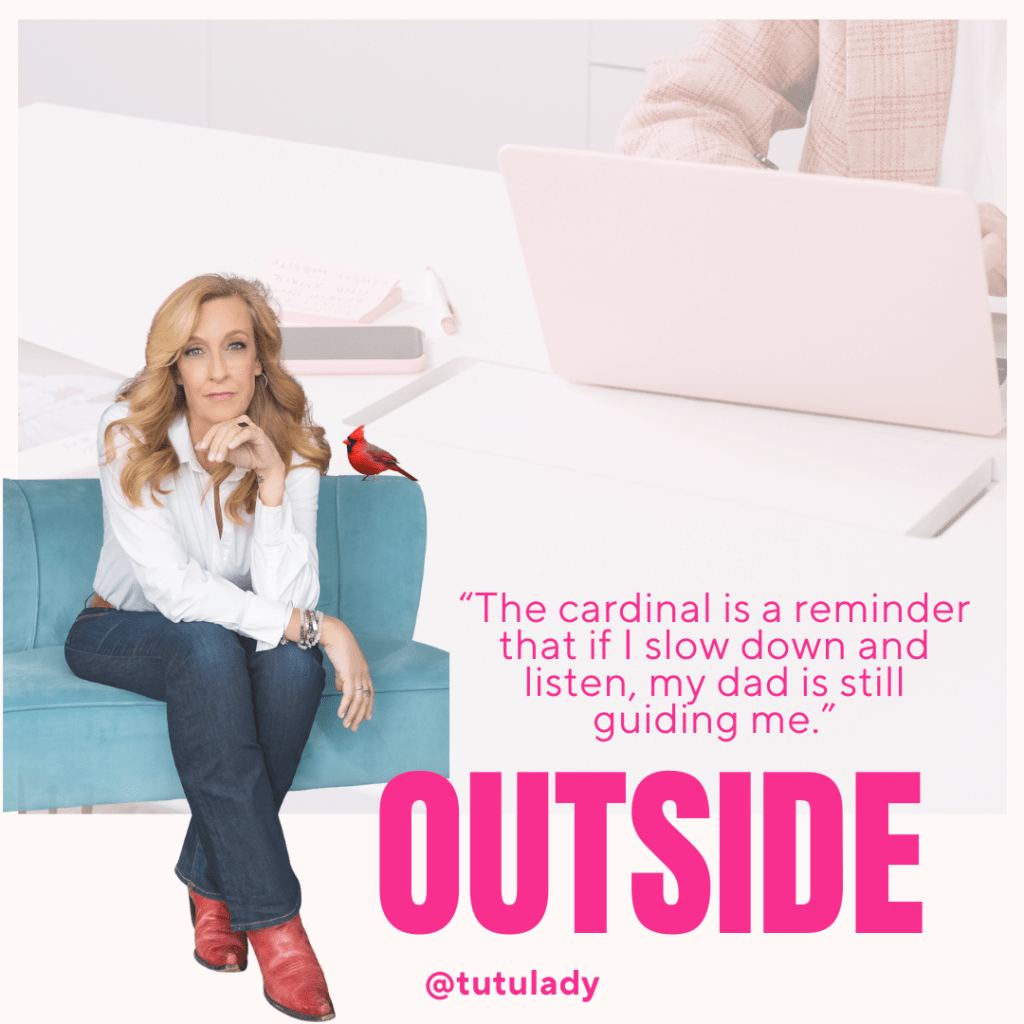
It is a reminder that he is still with me, that he is watching me, that somehow, in ways I cannot fully explain, he is still part of my life. And every time I hear that call before I see him, it feels like a gentle nudge. Like he is reminding me that if I slow down, if I listen, he will guide me.
I look for signs everywhere now. I move through my day asking the universe, sometimes quietly and sometimes not so quietly, to show me that my people are still with me. And I see them. In hearts that appear in unexpected places, in cardinals, in hawks, in flowers that seem a little too perfectly placed to be random. I choose to believe those moments are not accidents. I choose to believe they are connection.
But I also know this, I would miss all of it if I stayed inside.
Being outside clears something inside of me. With every inhale and exhale, something shifts. Something loosens. Something that has been sitting heavy inside my body finds a little more space to move and be removed.
Getting outside and moving my body during my divorce saved me. And that is not an exaggeration. It saved the fragile pieces of my mental health that were barely holding on at the time. It gave me somewhere to put the thoughts, the emotions, the questions that had nowhere else to go.
Over the past two years, while caring for my parents, it saved me again. In the middle of responsibility, stress, and anticipatory grief, those walks became a lifeline. A place where I could breathe, even if just for a little while. And now, in this new and different season of grief, I can feel it doing the same thing once more. It is helping me find my way back to myself, slowly, quietly, one step at a time.
There is something about being outside, about breathing in fresh air and feeling the elements against my skin, that makes me feel more alive than almost anything else. It reminds me that my body is still here, still capable, still moving forward even when my heart feels heavy.
It does not fix everything.
But it softens things.
And sometimes, that is enough.

Peace,
#tutulady
#forwardisapace

Stillness

As a 60th birthday gift to myself, I joined a gym. This may not sound like a particularly profound milestone, but for me it felt like a quiet act of defiance against a year that had taken more out of me than I expected. I told myself that no matter what else life threw my way, this would be something I did for me. And somewhat to my own surprise, I have not missed a single day since I started. Every. Single. Day. Some days I work out harder than others. Some days it’s cardio, some days it’s weights, and some days the workout is generous enough to be described as “movement.” But I show up. Consistency, it turns out, is sometimes more important than intensity.
The one part of the routine I never skip is the sauna. Fifteen to twenty minutes in that heat feels like something is leaving my body that has been stuck there for too long. I’m sure there are impressive physiological explanations for why this is good for me, and I’m happy to claim all the health benefits experts talk about. But what I notice most are the mental ones. Sitting in that heat, sweating out the day, feels like a release valve for the parts of grief and stress that quietly accumulate in the body. Apparently grief is not only emotional, it is also very committed to setting up residence in my shoulders.
Most of my days are anything but quiet. Teaching means I am “on” from the moment I walk into the building. Decisions, conversations, explanations, encouragement, redirection…lather, rinse and repeat. My brain rarely gets a break. After school there are more conversations, more responsibilities, and the drive home is usually spent catching up with friends or returning calls that have been waiting patiently for my attention. My life is full of people, which is a blessing I do not take lightly, but it also means that stillness is not something that naturally appears in my day.
Then I get to the gym and something shifts.
No one there knows me. No one knows my story or the things I am carrying. No one knows about my grief, my pride, my resilience, or the complicated chapters that have brought me to this moment. To them I am simply another person on a treadmill or lifting a weight or quietly existing in the corner of the sauna. I am just taking up space, which turns out to be incredibly freeing.
It is the same now when I walk or run. I put my phone on do not disturb and go. No one is asking questions, no one needs answers, and no one expects anything from me. It was never that way before until now. I do not have to explain myself or justify my emotions or revisit demons I am not particularly interested in entertaining that day. It is just me and my thoughts. The ones I choose to engage with and the ones that show up uninvited, which…if we are being honest… is how most thoughts operate anyway.
Recently I have also attended a few meditation sessions, which has been an interesting development for someone whose mind has historically operated like a browser with 47 tabs open at once. I learned about the “monkey mind,” the restless mental chatter that hops from one thought to another without ever fully settling. Sitting in stillness does not come naturally to me. In fact, the first time I tried it, my brain seemed determined to remind me of everything from my grocery list I forgot to buy in 2007.
But something interesting happened afterward. When the meditation ended, I felt an immense sense of peace, followed by a kind of exhaustion that feels strangely familiar. It is the same tiredness you feel after running a long race. Apparently, sitting still with your thoughts can be just as demanding as running a marathon—who knew?
Grief has changed the rhythm of my life in ways I am still learning to understand. There is a natural tension in being human between belonging and solitude. We need connection, community, laughter, and the comfort of knowing someone else is walking beside us. But we also need solitude. We need quiet spaces where we can sit with our thoughts and make sense of the emotions that don’t always behave politely enough to appear on a convenient schedule.
When grief enters your life, that rhythm becomes exaggerated. Some days you crave the presence of other people because being alone feels like standing in an echo chamber of sadness. Other days even the smallest interaction feels overwhelming, and what you want most is silence. The pendulum swings back and forth between connection and solitude, and learning to follow that rhythm becomes part of the work of healing.
The truth is that much of grief is experienced alone. In those quiet hours, when the world is not asking anything of us, we sit with loss and slowly begin the difficult work of understanding it. In that stillness, sorrow begins to transform. It becomes deeper, more complex, and eventually…. if we allow it…. something that can expand our capacity for compassion.
My therapist and others who have gently guided me through this season keep telling me the same thing: the answers I am searching for will come in the stillness.
This is mildly inconvenient advice for someone who was raised to believe that movement equals progress and productivity equals worth. I was conditioned to stay busy, stay useful, and stay in motion. Rest was seen as weakness and sitting still was NEVER an option. If you were tired, you probably just needed to work harder. If you were struggling, the solution was to keep going in order to outrun it.
Stillness was never presented or accepted as an option.
So learning to sit quietly with my thoughts has become its own kind of practice. I am learning that movement does not always have to be loud or fast to count. Sometimes movement is subtle. Sometimes it is simply the act of allowing yourself to feel something instead of outrunning it.
Either way, I am worthy.
Either way, I am doing enough.
So these days I find myself gravitating toward the quiet places more often. The sauna. The treadmill. A long walk where no one knows my name and no one needs anything from me. No music, no books, no phone calls—just the noise of my own brain, which, depending on the day, can be the loudest sound in the world.
Learning to listen to that noise…. and eventually quiet it…. is a skill I am still developing.
Slowly.
And I am beginning to suspect that slowly might be exactly the pace that grief requires.

Peace,
#tutulady
#forwardisapace

Becoming

There is a stage of life that no one really prepares you for, and lately I have realized that I am standing right in the middle of it.
We spend so much of our lives planning the obvious milestones. College. Careers. Marriage. Babies. Houses. Retirement accounts. The whole thing gets mapped out like a timeline we are supposed to follow. There are books, podcasts, experts, and entire industries devoted to helping people navigate those stages. But this stage? The one where the roles that once defined your life quietly shift or even disappear? That part seems to get skipped entirely.
And yet here I am.
For years I was the director of my children’s lives. I scheduled things, organized things, advised on things, and occasionally insisted on things. Now I have moved into a role that no one warned me about: audience member. I am in the stands cheering them on as they build their own lives, trying very hard not to yell unsolicited advice from the sidelines like a slightly overenthusiastic sports/stage mom clapping as loud as I possibly can at every chance I get. It is a beautiful transition, but it is still a transition.
At the same time, another role in my life quietly ended. For the past few years I was a caretaker for my parents, and when they passed away that responsibility ended in a way that left a space I had never really anticipated. When you have been responsible for others for so long, it is a strange realization to wake up one day and understand that the person you are now responsible for caring for is… you.
Caretaker of myself.
That is a role I never really planned for, and it turns out there is no instruction manual for it. No one sits you down and says, “Here’s what happens when your children are grown, your parents are gone, and you suddenly have to figure out who you are outside of the roles that filled your life for decades.”
Maybe that is why this season feels a little unsteady. Not wrong. Not sad or happy all the time. Just unfamiliar. Although, to be fair, the unsteady feeling could also be my joints reminding me that I am sixty. It is hard to say which is which some days.
Sixty is an interesting number because it sounds enormous when you say it out loud, yet somehow my brain did not get the memo. In my head I feel much younger than that. My body occasionally disagrees, but overall it is still cooperating well enough. There are a few more aches than there used to be, but nothing a little stretching, movement, and mild denial cannot handle.
And despite the uncertainty, life actually feels pretty full. I pay my own bills. I make my own decisions. If I want cheese and crackers for dinner, I have cheese and crackers for dinner and no one questions my life choices. If I want to stay up late reading, writing, or going down a rabbit hole of ideas for something new I want to build, I do that too. Some nights the house is quiet and peaceful, and other nights I am talking to the dog like he is a full participant in the conversation, which, based on the look he gives me, he clearly believes he is helping with the decision making process.
There is a certain freedom that comes with running your own life. I decide how I spend my time. I decide where my energy goes. If I want to sign up for something new, start a project, change direction, or sit with a cup of coffee and think about life for an hour, I can. There is no committee meeting required to approve the plan. There is also something deeply satisfying about realizing that the life around me is one I built myself over time, piece by piece.
And yes, I still sleep diagonally across the bed when I feel like it… unless the dog has claimed most of the mattress, which happens more often than I care to admit.
People sometimes assume that at this stage a woman must be looking for a partner, as though being single automatically means something is missing. As if there is a box on the life checklist that still needs to be filled in. But the truth is that I am perfectly content with my life as it is. I have built a life that feels full, meaningful, and mine.
If a partner ever enters the picture, they will need to be a one hundred percent value add to my life. Not a fixer-upper project. Not someone who needs to be managed, motivated, or mothered. I am long past the stage of my life where I am interested in taking on another full-time emotional renovation project. At this point, anyone who joins my life should arrive with their own life already intact.
Someone who brings joy, laughter, and partnership to the table. Someone who makes the good parts of life even better, not someone who complicates the peace I have worked hard to create. Otherwise, I am quite happy running my own life, making my own decisions, and yes… sleeping diagonally across the bed.
What I do find myself wondering about, though, is how many other women are standing in this same space.
How many of us are just a bit past the midpoint of life and realizing that there is still so much living left to do, while also recognizing that the structure of our lives has shifted in ways we never really planned for? We are no longer raising small children. Many of us are navigating the loss of parents or other loved ones. The roles that once defined us are evolving, and we are discovering who we are when we are no longer primarily responsible for everyone else.
The loss of my parents is still very raw, and grief has a way of rearranging the furniture in your life whether you are ready for it or not. Some days I feel strong and clear about what comes next, and other days I feel like I am simply doing my best to put one thoughtful foot in front of the other. But somewhere inside all of that is the quiet understanding that this is now my time to discover what my life looks like in this new space.
It is a space that many women never really get the chance to explore. Sometimes that is because they have a partner whose life direction becomes intertwined with their own. Sometimes it is because life moves so quickly that there is never time to stop and ask, What do I want now? And sometimes, if we are honest, it is simply fear. Fear of stepping outside the roles we have known for decades. Fear of the unknown. Fear of standing in a place where there is no clear guidebook.
Because there really isn’t one.
This era of life does not come with instructions. There is no neatly packaged plan for what to do when your children are grown, your parents are gone, and you suddenly realize that the next chapter of your life is largely yours to design.
That realization is both terrifying and incredibly liberating.
So for now, I am doing what I have always done when life feels uncertain. I am moving forward, learning as I go, and paying attention to what feels meaningful. I am allowing myself the space to grieve, the space to grow, and the space to imagine what this next era might hold.
And I suspect I am not the only woman standing in this place.
Which is why I find myself thinking more and more about community. About women walking alongside one another through this stage of life instead of quietly trying to figure it all out alone. Women who are still very much in their prime, still curious, still capable, still full of life, but also honest about the fact that this chapter comes with questions.
Maybe together we can help create the path that none of us were given. We can support one another as we figure out what this next era looks like, share what we are learning along the way, and build something that not only helps us move forward but also creates space for the women who will come after us.
Because while there may not be a guidebook for this part of life, there is something powerful about realizing that we have the ability to write it ourselves.
And for now, I will keep doing the one thing I know how to do.
Moving forward.
Because forward is a pace.

Peace,
#tutulady
#forwardisapace

Undercurrent

Earlier this week, grief knocked the wind out of me. Literally took me down and out.
I’m only writing about it now because I needed time to process what happened. It took sitting with it for a few days and talking it through in therapy before I could really understand it enough to put words to it.
It started in the most ordinary way. I drove to work like I always do…. same streets, same turns, same parking spot. I pulled in, turned off the car, and then just sat there. And I couldn’t get out. The building was right in front of me. My bag was on the seat. Nothing was different, and yet everything felt impossibly heavy.
The strangest part was that I don’t even know what caused it. There wasn’t a specific memory or moment. It was like a wave came out of nowhere, took me under, and I couldn’t seem to come up for air. I was completely consumed by my own sadness. Nothing made it feel better, and that part scared me. It felt like I was in a spiral of sadness with no clear reason why.
I texted a friend who knows me well enough to give me exactly what I needed…. a little empathy and a little tough love. Eventually I took a breath, opened the car door, and went inside.
From the outside, the day probably looked normal. Work went on. Conversations happened. The usual rhythm of the day moved forward. But all day I was holding back tears. The smallest things would make my eyes well up….. a kind word, a quiet moment, a passing thought. Nothing dramatic, just the weight of grief sitting right under the surface.
There are moments lately where I almost wish I could just wear a sign so people would understand. Something that says “Caution: grieving.” Or maybe “Hey… be nice. My parents died this year.” Or even the blunt truth: “Hey… my parents are dead.” Not because I want sympathy, but because grief makes you realize how many people are walking around carrying things no one else can see.
In the past, I probably would have suffered through something like that in silence. I would have pushed it down, smiled, and pretended everything was fine. But not anymore. I told my coworkers I was having a hard day and tried to explain how I was feeling. I could not accurately put it into words. They may not have fully understood, but they were kind. They checked on me throughout the day, offered support, and gave me space when I needed it. That mattered more than they probably realized.
One of the things I talked about in therapy later that week is how little space our society really gives to grief. In some cultures, people wear black and are openly in mourning for a year. The loss is visible. The grief is acknowledged. It is understood that healing takes time.
Here, we get a few days off. Then we’re expected to return to life as usual, even though nothing inside of us feels usual anymore.
So when grief shows up months later, or on a random weekday morning in a parking lot, it can hit hard. It can feel like a wave that knocks you down before you even see it coming.
Earlier this week it took me down and tried to pull me under. But the thing I keep coming back to is this: I didn’t drown.
I reached out to a friend. I told the truth about how I was feeling. I let the people around me see that I was struggling instead of pretending I was fine. And somehow, that felt like progress.
Grief is still there. It will probably always be there in some form. But I’m learning that letting people see it, letting them sit beside me in it, is not weakness. It’s part of healing.
And maybe that’s the quiet lesson grief is teaching me now.
The waves may still come, but I am stronger than the ones that try to pull me under. I am learning to swim and surf.

Peace,
#tutulady
#forwardisapace