Peace

For years, I heard some version of the same warning. “You’ll wind up alone.” “No one will ever love you.” Sometimes it was said as a threat. Sometimes as a prediction. And sometimes, I suspect, it was meant to make me question whether I could possibly build a happy life on my own. Before my divorce, during it, and even afterward, the message was remarkably consistent. Being alone was apparently the worst possible outcome for a woman. Something to fear. Something to avoid. Something that meant you had somehow failed at life.

Even my parents worried about it. Not because they doubted my ability to take care of myself, but because they loved me and wanted me to have someone to share my life with. I think they genuinely believed that being alone meant being lonely, and they didn’t want that for their daughter. And for a while, I wondered whether everyone was right. Would I end up alone? Would I regret leaving? Would there come a day when the silence in my house felt unbearable? Would I look around and realize that everyone else had someone and I had somehow missed my chance?

Well, here I am. Alone. And I have to tell you, I rather like it.

My house stays exactly the way I left it. The dishes are where I put them. The laundry is mine. The remote is mine. The thermostat is mine. Nobody is asking where something is while standing directly in front of it. It’s a beautiful thing. Of course, there is the dog, who occasionally seems determined to test the limits of my commitment to domestic tranquility. I can only assume that when I’m gone, he’s hosting some sort of underground canine social club. The evidence is sometimes compelling. But aside from his questionable housekeeping habits, my home is peaceful. And I have come to understand just how valuable that is.

I spend my days working with middle schoolers. Middle schoolers with big personalities, big emotions, big opinions, and absolutely no shortage of noise. I love what I do, but anyone who has spent five minutes in a middle school knows that peace and quiet are not exactly part of the daily curriculum. By the time I get home, I have listened, redirected, encouraged, negotiated, problem-solved, repeated myself approximately 847 times, and occasionally questioned whether anyone in the building has ever heard the phrase “inside voice.” So when I walk through my front door and the only creature demanding something from me has four legs and a questionable understanding of personal space, I am perfectly content.

For years, I signed my emails with one word. Peace. Not “Best regards.” Not “Sincerely.” Just peace. I have peace signs throughout my home and my life. I’ve collected them, displayed them, worn them, and used them as a reminder of what I wanted more than anything. Peace wasn’t just a cute little sign-off or a decorative theme. It was a mantra. Something I was searching for long before I fully understood what it would look like when I found it. And somewhere along the way, I realized that I had manifested exactly what I’d been asking for.

I have peace. But lately, I’ve been wondering if perhaps I peaced a little too hard.

Because somewhere between protecting my peace and enjoying my solitude, I may have swung the pendulum a little too far in the other direction. And that’s an interesting thing to admit. After spending so many years navigating chaos, conflict, disappointment, and the emotional demands of other people, peace became more than something I wanted. It became something I fiercely protected. I built boundaries, learned to say no, stopped explaining myself quite so much, and became very comfortable with my own company. All good things. But I think somewhere along the way, I started confusing protecting my peace with avoiding anything that might disturb it. And those aren’t necessarily the same thing.

Because here’s what I’m beginning to realize. A peaceful life isn’t necessarily a joyful life. And while the two can absolutely coexist, one doesn’t automatically guarantee the other. I’ve become very good at being alone. Perhaps a little too good.

I can fill my days with work, books, needlepoint, walks, music, and all the little routines that make a life feel comfortable. I can come home, close the door, and know that nobody is going to ask anything of me. Nobody is going to disappoint me, challenge me, or require more emotional energy than I feel like giving. And after everything I’ve experienced, that has felt like a tremendous accomplishment. But comfort can become a very convincing hiding place. And I think I’ve been hiding a little.

Not from life exactly, but perhaps from the unpredictability of it. From the possibility of disappointment. From the vulnerability that comes with letting people in, making plans, taking chances, and allowing life to get a little messy again. Because the truth is, joy isn’t always quiet. Sometimes joy is loud and spontaneous and inconvenient. Sometimes it requires getting dressed when you’d rather stay in your pajamas. Sometimes it means saying yes to an invitation when your first instinct is to stay home. Sometimes it means opening yourself up to people, experiences, and possibilities without knowing exactly how they’ll turn out.

And sometimes joy comes with the very real possibility of getting hurt. I’ve had enough hurt to last a lifetime, thank you very much. But I don’t want the fear of more hurt to keep me from experiencing more happiness. That’s the part I’m working on now.

For so long, the goal was to find peace. To build a life where I wasn’t constantly reacting to someone else’s moods, managing someone else’s expectations, or trying to keep everyone happy at the expense of myself. And I did that. I built a life I genuinely love. I learned to enjoy my own company. I discovered that being alone and being lonely are two very different things. I stopped believing that having a partner was somehow proof that my life was complete. I still believe all of that.

Would I like someone to go to dinner with once in a while? Absolutely. Someone to share the funny stories from my day? Someone to travel with, see a concert with, or sit across from over a glass of wine and have a great conversation? Of course. But I still have absolutely no interest in managing another adult. I’ve raised five children, spent a lifetime taking care of people, and earned the right to retire from unpaid household management. The position remains closed.

What I am realizing, though, is that I don’t have to choose between protecting my peace and inviting more joy into my life. I can have boundaries without building walls. I can enjoy solitude without making isolation my default setting. I can be independent without insisting that I never need anyone. And I can allow people into my life without handing them the keys to my happiness.

Perhaps the biggest lesson is that peace doesn’t have to mean the absence of disruption. Sometimes it means trusting myself enough to know that I can handle a little disruption without losing who I am. After all, I’ve navigated divorce, grief, caregiving, complicated relationships, and more unexpected turns than I care to count. I’ve learned to ride some pretty enormous emotional waves. Surely I can survive a dinner invitation that turns out to be less than spectacular. Worst-case scenario, I get a good story out of it. And I do love a good story.

I think this is another one of those lessons that comes with getting older. We spend so much time trying to find balance, only to discover that balance isn’t something we achieve once and then check off the list. It’s something we have to keep adjusting as our lives change. For a long time, I was leaning so far toward everyone else’s needs that I nearly fell over. Then I finally learned to lean toward myself. And apparently, in true me fashion, I may have overcorrected. Who knew you could overachieve at peace? But here we are.

The answer isn’t to swing all the way back. I have no intention of returning to a life where my own needs come last, where boundaries are optional, or where I mistake being needed for being loved. I’ve worked too hard to get here. What I want now is a little more balance. More laughter. More spontaneity. More connection. More moments that remind me that life is meant to be lived, not simply managed. More joy.

Not because my life is lacking or because I need someone else to complete it, but because I don’t want to become so comfortable protecting the life I’ve built that I forget to fully enjoy it. I want to keep my quiet mornings, my peaceful evenings, my books, my needlepoint, and my freedom to do absolutely nothing when I feel like it. But I also want to say yes a little more often. To make plans. To be surprised. To let people in. To remember that some of the best moments in life are the ones we never could have planned. And maybe even let someone move the thermostat occasionally. Let’s not get carried away. Baby steps.

For years, I thought finding peace was the destination. And perhaps, for that chapter of my life, it was. But I’m beginning to understand that peace was never supposed to be the end of the story. It was supposed to give me the freedom to write the next chapter. And I don’t want that chapter to be so quiet that I miss the music.

So, am I alone? Yes. Am I happy with the life I’ve built? Absolutely. Do I still love my peace? More than ever. But I’m also learning that I can love my peace and make room for more joy. That letting life get a little louder doesn’t mean inviting chaos back in. And that being open to connection doesn’t mean surrendering the independence I’ve worked so hard to find.

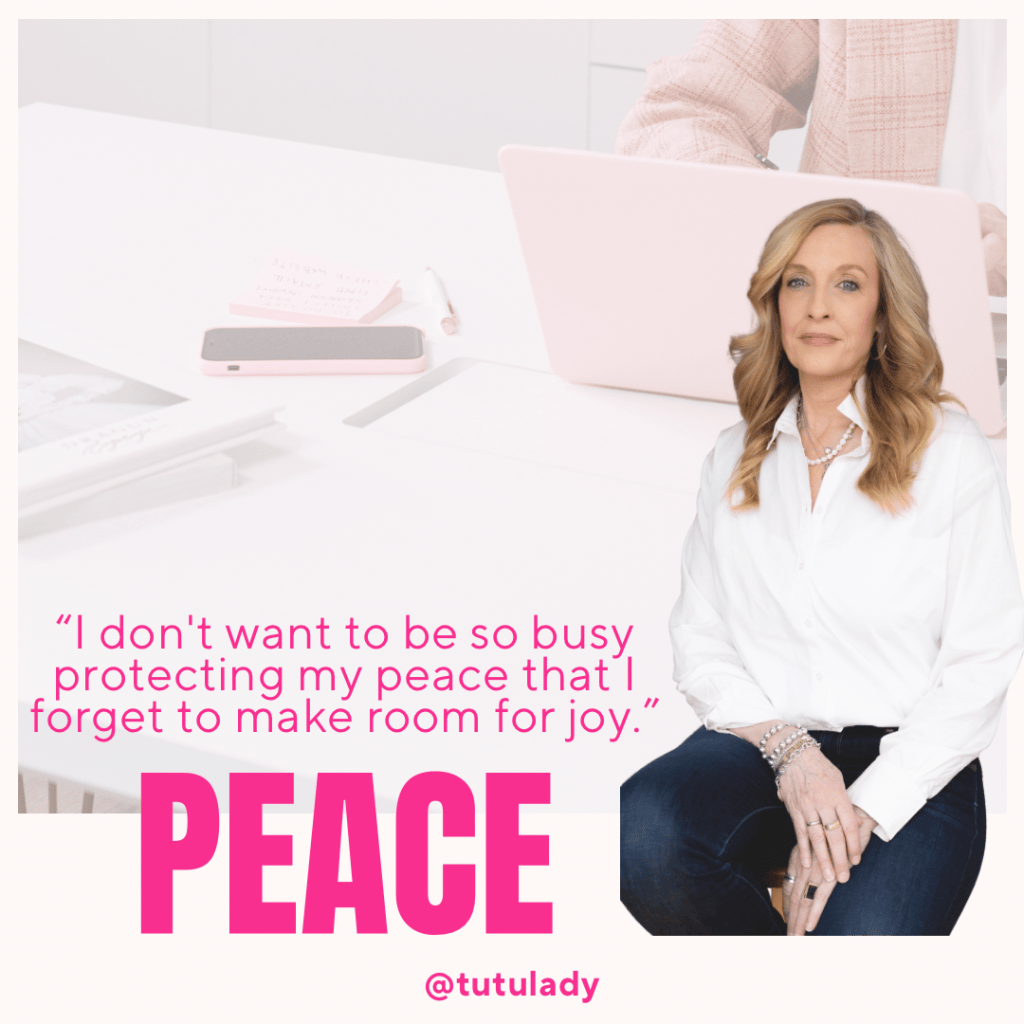
I spent years manifesting peace. I found it. Now it’s time to make sure I’m actually living in it. Because I don’t want to be so busy protecting my peace that I forget to make room for joy. And perhaps that’s what this next chapter is about. Not choosing one over the other. Just finding my balance again.

Peace. And joy. I think there’s room for both.
Chosen

My therapist asked me a question recently that stopped me in my tracks. “What if you started seeing yourself through the eyes of the people who appreciate you, rather than through the eyes of the people whose approval you’ve been trying to win?”
Well, damn…..
Because if I’m being truthful, I have spent a good portion of my life trying to be enough for people who don’t always see me that way. And nowhere has that been more complicated than in motherhood.
I have five adult children. Five people I love more than I could ever adequately put into words. Five people I spent decades raising, worrying about, advocating for, celebrating, and occasionally wanting to sell to the circus.
And now they’re adults. Which, by the way, nobody really prepares you for. We spend years learning how to be mothers. We read the books, make the appointments, pack the lunches, remember the birthdays, and sit through the games, concerts, conferences, and performances. We lose sleep over fevers, friendships, heartbreaks, and decisions that aren’t ours to make. We become experts in anticipating what everyone needs, sometimes before they even know they need it. And somewhere along the way, we forget to ask ourselves what WE need.
Then one day, the children grow up. They build lives, find partners, establish traditions and routines that don’t necessarily include us, and make decisions without asking our opinions. Which is exactly what we raised them to do. And we are proud. So incredibly proud. But there’s a strange grief that comes with raising independent adults. You spend years being essential to someone’s everyday life, and suddenly you’re optional. Nobody tells you how to navigate that. Nobody tells you how to stop measuring your worth by how often the phone rings, how often you get a text, whether you’re invited, or whether someone chooses to spend time with you. And nobody tells you how much it can hurt to realize that the people you would choose first every single time might not always choose you at all.
I’ve had this conversation with so many women, often in hushed tones, as though we’re confessing some terrible maternal sin. We talk about feeling left out, unappreciated, or unsure of where we fit in our adult children’s lives. We admit that sometimes we’re lonely, sometimes we’re hurt, and sometimes we’d just like someone to text or, god forbid….. make a phone call…… because they actually WANT to talk to us, not because they need the family Netflix password. And then, almost inevitably, we feel guilty for saying any of it. Because somewhere along the way, women were handed the ridiculous expectation that good mothers should be endlessly giving, endlessly available, and endlessly grateful for whatever scraps of attention come our way. We’re supposed to be thrilled that our children are independent, never mind that independence occasionally feels like we’ve been laid off from a job we worked around the clock for decades. No severance package, no retirement party, and apparently no exit interview.
And heaven forbid we admit that we want something for ourselves…. that we want to be included, appreciated, or even chosen. Somehow, wanting a life outside of motherhood is still treated as selfish, while sacrificing every bit of ourselves is practically a competitive sport. We’ve been conditioned to believe that a good mother puts herself last. And after decades of doing exactly that, we’re supposed to magically know how to put ourselves first without feeling guilty. I’d love to know who came up with this arrangement because I’d like a word.
I have spent years examining my mistakes, apologizing for things I wish I had done differently, and trying to repair relationships complicated by divorce, changing family dynamics, and the simple fact that we’re all human. I believe in accountability and growth. I believe we can acknowledge the ways we’ve hurt people without allowing those mistakes to become our entire identity. But I’m beginning to understand that there is a difference between taking responsibility for your past and spending the rest of your life apologizing and trying to earn forgiveness. There is an enormous difference between loving someone and needing their approval to feel worthy of love. And at some point, continuing to audition for a role you’ve already spent decades playing becomes exhausting.
I think that’s where I find myself these days. Trying to figure out how to be the mother of adults without losing myself in the process. Learning when to reach out and when to give space, when to offer advice and when to keep my mouth shut. (That last one remains a work in progress!) And perhaps most importantly, trying to understand that their choices are not necessarily a reflection of my worth. I can know all of this intellectually and still feel hurt when I’m not included or when my efforts seem to go unnoticed/unacknowledged. Knowing something and actually living it are two very different things. Apparently, at sixty, there are still plenty of lessons left to learn.
Because here’s the thing. There are people in my life who genuinely enjoy my company. People who invite me places, laugh at my ridiculous stories, appreciate my kindness, my humor, my occasionally inappropriate commentary, and my ability to show up with snacks, flowers, or whatever else might make someone’s day a little better. There are friends who choose me, colleagues who appreciate me, and former students who remember me. People who see the good in me without requiring a dissertation on everything I’ve ever done wrong. And yet, how often do I overlook all of that because I’m focused on the approval I haven’t received? How many wonderful moments have I diminished because I was thinking about who wasn’t there? Too many, I’m afraid.
Maybe that’s the lesson I’m supposed to be learning in this season. Not how to make people choose me, but how to stop abandoning myself while waiting for them. For nearly sixty years, I’ve been somebody’s daughter, sister, wife, mother, teacher, friend, caregiver, and problem solver. I’ve spent a lifetime making sure everyone else had what they needed, often at the expense of figuring out what I needed. And now, with my children grown, no partner and both of my parents gone, I’m finding myself in a place I never anticipated. For the first time in my adult life, there isn’t someone who depends on me in quite the same way. There is freedom in that, certainly, but there is also a loneliness that I don’t think we talk about nearly enough.
I’m learning to ask myself questions that once seemed almost selfish. What do I want to do today? Where do I want to go? What would make ME happy? Not what would make me useful, or what would make someone proud of me, or what might earn me an invitation or a little more affection. Just what would bring me joy. Maybe it’s taking a long walk with no particular destination. Maybe it’s eating exactly what I want without worrying about anyone else’s preferences. Maybe it’s spending an entire afternoon reading, needlepointing, or doing absolutely nothing productive. Imagine that. A woman who spent decades taking care of everyone else deciding that her own happiness deserves a place on the calendar. Revolutionary stuff, right?
And none of this means I love my children any less. I will always be their mother. I will always celebrate their successes, worry when life gets hard, and hope they know there’s always a safe place to land with me. But I also want relationships with them that grow because we enjoy each other, not because I am constantly trying to prove that I deserve a place. I want to know them as adults, and I want them to know me as a person, not simply as the woman who raised them. I want to laugh with them, share experiences, make new memories, and build something different from the relationships we had when they were little. And I want to leave room for those relationships to evolve, even when that evolution doesn’t happen on my timeline ……which, for the record, would probably be yesterday.
I’m beginning to realize that I can love them fiercely without chasing them. I can leave the door open without standing in the doorway waiting. I can acknowledge the hurt without making it the center of my life. And I can be proud of the mother I’ve been while still becoming the woman I want to be. Maybe that’s what this next chapter is really about. Learning that I don’t have to audition for a place in anyone’s life. Learning that being needed and being loved are not the same thing. Learning that my worth didn’t disappear when my children stopped needing me to manage their everyday lives. And learning to look at myself through the eyes of the people who already see something wonderful in me, including, eventually, my own.
I’m still figuring it out. Some days are easier than others. Some days the hurt gets the better of me, and I find myself wondering what I could do differently to be more lovable, more appreciated, more included. I can recognize that I have a full and beautiful life and still wish certain people were more present in it. Those feelings can coexist. Grief and joy have been sharing space in my life for a while now, and apparently they’re making room for a few more complicated emotions. But I’m getting better at recognizing when I’m allowing someone else’s choices to determine how I feel about myself. And I’m reminding myself that I am allowed to have a beautiful, full, joyful life even when some of the relationships I treasure aren’t what I wish they were.
Perhaps the most important thing I’m learning is that I don’t have to stop loving anyone to start loving myself. I don’t have to become harder, colder, or less available. I can remain the person who loves deeply, shows up, remembers the little things, and believes in the importance of family. But I can also extend some of that same tenderness, patience, and generosity to myself. After all, I’ve spent a lifetime teaching my children that they are worthy of love simply because of who they are. Maybe it’s time I started believing that about myself.
And maybe it’s time we stopped treating mothers who want something for themselves as though they’ve violated some sacred oath of self-sacrifice. We chose to be mothers and raise humans, we did not sign up for a lifelong obligation to erase ourselves.
So I’m returning to that question. What if I started seeing myself through the eyes of the people who appreciate me instead of the people whose approval I’ve been trying to win? What if I stopped keeping score of the invitations I didn’t receive and started appreciating the ones I did? What if I stopped wondering why someone didn’t choose me and started paying attention to all the people who do? And what if, after all these years of putting everyone else first, I finally gave myself permission to build a life that I love, regardless of who decides to be part of it?
I don’t have all the answers. But I do know that motherhood doesn’t end when our children grow up. It evolves, and so must we. Maybe this next season isn’t about doing more, trying harder, or proving our worth. Maybe it’s about trusting that the love we’ve given matters, even when it isn’t acknowledged in the ways we’d hoped. Maybe it’s about finding joy in being a mother without allowing motherhood to be the only thing that defines us. And maybe, after all these years of choosing everyone else, it’s time to choose ourselves, too. Not instead of them, but alongside them. Because wanting to be loved, appreciated, and included doesn’t make us needy. It makes us human. And wanting a life of our own doesn’t make us selfish. It makes us women who finally understand that we matter, too.

Peace,
#tutulady
#forwardisapace

Nine

It has been nine years since I signed the papers that officially ended my marriage. Eleven years since the whole process began. If you had shown the woman I was eleven years ago a picture of my life today and told her, This is where you’re going to end up, I would not have believed you. Actually, I probably would have laughed at you. And depending on what particular day of those eleven years you caught me on, I might have had a few other choice words for you too. But here we are.
Every year when this date rolls around, I think about what I have learned since signing those papers. You would think after nine years I would have this whole post-divorce, rebuilding-a-life thing figured out. Apparently, life did not get that memo. The list of things I continue to learn just keeps getting longer, and this year I think one of the biggest lessons has been that loss comes in so many more forms than I ever understood.
We tend to think about loss as death, and unfortunately I now understand that kind of loss far better than I ever wanted to. But there are so many other losses we don’t really talk about. There is the loss of a marriage and the family you thought you would always have. The loss of the dreams you had for yourself and others. The loss of relationships with people who are still very much alive. The loss of friendships, traditions, jobs, homes, plans, expectations and versions of ourselves we thought would be around forever. Sometimes there isn’t a funeral or a sympathy card or even an acknowledgment that something important has ended. You just wake up one day and realize that something you thought would always be there isn’t anymore.
And grief, as it turns out, is just as creative. Sometimes it arrives exactly when you expect it. Other times it sneaks up on you in the grocery store, on a walk, while driving, or because some song you have heard 847 times suddenly decides that today it is going to destroy you. Grief has absolutely no respect for schedules, plans or the fact that you just put mascara on. Rude.
Recently, I wrote about finally giving my grief a name. I call her Edith. Naming her has helped me understand that grief isn’t something I am going to conquer or eventually leave behind. Edith and I are apparently in this for the long haul, so we are learning how to live together. Some days she sits quietly in the corner and lets me get on with things. Other days she makes herself entirely too comfortable and acts like she owns the place. We didn’t choose each other, but if we’re going to be together, we’re learning to make the best of the arrangement. And maybe that’s another thing these nine years have taught me: not everything we carry has to disappear for us to keep moving forward.
Because loss comes in many forms, grief comes in many forms, but so does joy. So does happiness. And so does peace.
I think for a long time I expected happiness to look big. I thought rebuilding a life meant creating some shiny, fabulous new one that would prove everything had worked out. But some of the happiest parts of my life now are ridiculously ordinary. The sun on my face during a morning walk. Music in my ears. A really good book. Laughing with my kids. A conversation with a stranger I almost didn’t stop to have. Sitting in my own home and realizing how peaceful it feels. Going somewhere by myself and not thinking twice about it. Making plans because I want to make them and changing them because I want to change them.
There is a freedom in that which the woman from eleven years ago couldn’t possibly have understood. And I don’t just mean the freedom that came with signing those papers. That was one kind of freedom, certainly. But there is another kind that has taken me much longer to recognize.
There is a certain freedom that comes with the release of all the expectations attached to the people and relationships you lose along the way.
For much of my life, I carried a lot of ideas about who I was supposed to be. A wife should do this. A mother should do that. A daughter should be this. A friend should be that. This person expects this from me, that person needs that from me, and somewhere in all of those expectations was the person I thought everyone needed me to be. Some of those expectations were spoken. Plenty of them weren’t. And, if we’re being fair, more than a few of them were probably expectations I put on myself and then conveniently blamed on everyone else.
But when relationships change or end, something unexpected can happen. The expectations connected to them begin to fall away too. Sometimes painfully. Sometimes slowly. And sometimes with the surprising realization of, Wait. I don’t have to do that anymore.
There is grief in that. Absolutely. But there can also be freedom.
Freedom to decide what actually matters to me now. Freedom to change my mind. Freedom to stop explaining choices that don’t require an explanation. Freedom to discover who I am when I am no longer trying to fulfill a role someone else assigned me… or one I assigned myself thirty years ago and somehow forgot I was allowed to resign from if I had the wherewithal.
Turns out, there was no exit interview required.
Peace has surprised me even more. I used to think peace came when everything was resolved. When all the questions had answers, all the relationships were repaired, everyone understood one another, apologies were given and received, and all the loose ends were tied into a pretty little bow. Ya know….that big kumbaya moment. Bless my heart. That is not how any of this works.
Sometimes peace is accepting that something will never be resolved. Sometimes it is realizing you don’t need someone else to understand your side of the story. Sometimes it is loving someone from a distance. Sometimes it is finally understanding that closure isn’t something another person hands you. And sometimes peace is simply realizing that you don’t have to attend every argument you’re invited to. That one? Well, it took me far too long to figure that out.
For years I also thought healing was a destination. Surely at some point I would arrive at this magical place called Healed, plant a little flag and be finished. Nine years later, I know better. Healing is messy and incredibly non-linear. It is learning and unlearning, losing and finding, grieving and laughing, moving forward and occasionally discovering that something you thought you dealt with five years ago has apparently been sitting quietly in the corner waiting for another turn. Again, rude.
That is probably why #forwardisapace means even more to me now than it did when I first started saying it. Forward hasn’t always looked impressive. Sometimes I ran. Sometimes I walked. Sometimes I crawled. There were plenty of times I was curled up on the bathroom floor because…well… it seemed safe. And there have been times when I had to go back and pick up a piece of myself I left somewhere along the way. I used to think that meant I was moving backward. Now I know better.
Nine years later, I have a lot more compassion for the woman who signed those papers. I don’t look back at her and wonder why she didn’t know more, do more or figure things out sooner. She knew what she knew at the time. She was doing the best she could with the information, strength and courage she had. She couldn’t have known what the next nine years would bring. Frankly, if someone had handed her the complete itinerary, she might have politely declined the trip.
Because she couldn’t have known about the losses that were coming. But she also couldn’t have known about the joy.
She didn’t know how much she would laugh again. She didn’t know how comfortable she would become in her own company or how fiercely she would learn to protect her peace. She didn’t know how many wonderful people she hadn’t met yet, how many places she hadn’t been, how many things she hadn’t tried, or how many times she would discover that she was capable of something she once thought she couldn’t do. Most of all, she didn’t know that someday she wouldn’t just survive a life she never planned. She would actually LIVE it and LIKE it!
Maybe that is the lesson of nine.
A beautiful life does not have to look anything like the life you originally planned. Joy and grief can exist in the same day, sometimes in the same damn hour. Happiness doesn’t mean you have stopped missing what you lost. Peace doesn’t require every story to have the ending you wanted. Freedom can come from things you chose to leave and, strangely enough, from things you never wanted to lose. And being okay doesn’t mean everything is okay. It just means you have learned that you can carry more than one truth at a time.
Eleven years ago, I couldn’t imagine this life. Nine years ago, I signed my name and walked away from one chapter without having the slightest idea what the next one would look like. Today, I still don’t know exactly what comes next. The difference is that I no longer need to.
There will be more loss because that is the price of loving people and having a life full enough to love things worth losing. There will be more grief. Edith will make sure of that. But there will also be more joy, more laughter, more love, more ridiculous stories, more mornings with the sun on my face, more people I haven’t met yet, more places I haven’t been and more pieces of myself I haven’t discovered.
So today I celebrate nine. Not because everything turned out the way I wanted it to. Good Lord, no. I celebrate because I am here. I am upright and above ground. Because I kept going. Because somewhere along the way I stopped trying to rebuild the life I thought I was supposed to have and started living the one that was actually mine.
If you had told me eleven years ago that this is what my life would look like today, I wouldn’t have believed you.
But here we are.
And I think I’ll stay awhile.

Peace,
#tutulady
#forwardisapace

Edith

I Finally Gave My Grief a Name.
I Call Her Edith.
When I first said those words out loud, they felt strange. Almost silly. Why would I name my grief?
The idea actually came from my therapist. She suggested that instead of thinking of grief as something that is me, I could think of it as someone who simply walks alongside me. Someone who has a name, a personality, and even human characteristics. She explained that if grief became a person instead of an emotion, I could begin to have a relationship with it. Some days it might come with me. Some days I might ask it to wait outside. Some days I might leave it at home entirely. The goal wasn’t to get rid of my grief. The goal was to stop believing that grief was who I was.
So, I named her Edith.
I don’t know exactly why I chose that name. Maybe it’s because Edith feels comfortable, like someone I’ve always known. Like a distant relative whose name I heard throughout my childhood but never really knew. Someone who was always there in family stories, yet remained a bit of a mystery. Over time, though, we’ve gotten to know each other. We’ve developed a relationship. It wasn’t exactly the relationship I would have chosen, but apparently Edith wasn’t asking for my opinion.
These days, Edith feels less like a stranger and more like an old sweater. She’s familiar. Comfortable. Soft around the edges. Sometimes I don’t even realize she’s wrapped herself around my shoulders until I stop and notice she’s there. Other days, she sits quietly in the corner, barely asking for my attention at all. She’s old-fashioned, quiet, and wise. She doesn’t demand attention, but she’s never very far away. She also has absolutely no concept of appropriate timing. She’s shown up in the grocery store because I walked past my dad’s favorite cookies, in the middle of a bookstore because I found one I wanted to tell him about, and at the beach because a sunset reminded me of my mom. I’ve gently suggested she work on her timing. She’s gently ignored me.
Some mornings Edith greets me before my feet hit the floor. She reminds me that my parents aren’t here to answer the phone and Kelly isn’t going to respond to my text. She sits beside me when I read a book I want to tell my dad about, catch the scent of my mom’s perfume on an old sweater, or hear a song Kelly loved. She also has impeccable timing if I’m wearing mascara. Other days, she’s barely noticeable. She lets me laugh with friends, lose myself in a good book, or watch a sunset without whispering in my ear. She’s still there—I know she is—but she gives me room to breathe and the space to experience joy without guilt. On those days, I like to imagine she’s off having coffee with someone else’s grief.
Giving my grief a name didn’t make it disappear. It made it understandable.
Before Edith, grief felt like an unpredictable wave crashing over me without warning. Now I recognize her. I can say, “Edith is having a hard day today,” instead of believing that I am falling apart. That small shift has changed more than I ever imagined.
Instead of fighting my grief, I can become curious about it. What does Edith need today? Sometimes she needs me to cry. Sometimes she needs me to tell another story about my parents because speaking their names keeps them close. Some days she wants me to read old messages from Kelly. Sometimes she simply wants to sit quietly beside me while I drink my morning coffee. She’s actually pretty low-maintenance. Coffee, a good cry, and the occasional old voicemail seem to keep her happy.
And sometimes, she doesn’t need to come with me at all.
There are days when I leave Edith at home. Not because I love the people I’ve lost any less. Not because I’ve forgotten them or “moved on.” But because grief doesn’t have to accompany me to every lunch with friends, every outing, every concert, or every joyful moment. She’ll still be there when I get home, and somehow I think she understands.
I’ve learned it’s healthy for us to spend a little time apart. Every relationship needs boundaries, right? Besides, if Edith came to every dinner, beach day, and concert, we’d probably both be exhausted. A little space is good for us. And truthfully, she’s gotten much better about letting me enjoy the happy moments before quietly reminding me that love and grief have always shared the same heart.
Perhaps that’s the greatest gift of naming her. I no longer see grief as something that happened to me or something I have to carry alone. I see her as a companion who arrived because love came first.
Edith only exists because my people existed. She walks beside me because my parents loved me. Because Kelly loved me. Because so many others left fingerprints on my heart that time could never erase. The depth of my grief is simply a reflection of the depth of my love. I wouldn’t know Edith if I hadn’t first known them.
If I had my druthers, I never would have chosen to meet her. If I had the choice, I’d trade every lesson she’s taught me for one more call, one more hug, one more ordinary day with the people I miss. But since she’s here, we’ve learned how to be together. Like every long-term relationship, we’ve found our rhythm. She reminds me to slow down and remember. I remind her that it’s okay for me to laugh, to travel, to fall in love with life again. We’ve discovered that there is room for both joy and sorrow, and neither one has to cancel out the other.
I’ve come to believe that grief isn’t the opposite of love. It’s love searching for somewhere to go. My love for my people doesn’t simply disappear. It still exists. It still needs somewhere to live. For me, it walks beside me. It bears the name Edith.
Maybe that’s why naming her has been so healing. It hasn’t made the grief smaller, and it certainly hasn’t made me miss my people any less. But it has reminded me that grief is not a sign that something is wrong. It’s evidence that I loved deeply and was loved in return.
We didn’t choose each other, Edith and I. But after spending this much time together, it seemed only right that we learned each other’s names.
The truth is, neither of us is going anywhere.
So we’ve learned to be together. We’ve learned each other’s rhythms. We’ve learned when to hold on a little tighter and when to give each other some space. And somewhere along the way, I stopped wishing she would disappear and started appreciating why she has become a part of my life.
Because without Edith, I don’t know that I would fully understand the depth of the love I was so fortunate to experience. She’s no longer just my grief. She’s become the keeper of my memories, the guardian of my love, and the gentle reminder that the people who shaped my life are still shaping my heart.
So now I’m curious…
If you gave your grief a name, what would it be? Or maybe it isn’t grief at all. Maybe it’s anxiety. Fear. Hope. Joy. Regret. Courage.
What would happen if, instead of trying to outrun that feeling, you invited it to sit beside you long enough to understand why it came? Sometimes the feelings we spend the most energy resisting are simply asking to be acknowledged.
Maybe they deserve a name.

Peace,
#tutulady
#forwardisapace

Figureoutable

I worry. A lot.

My therapist has a word for it: catastrophizing. I like to think of it as being exceptionally prepared for disasters that will probably never happen.
If there is a possible outcome, my brain has a remarkable ability to skip over the likely ones and head straight for the worst-case scenario. I can take a simple uncertainty and turn it into a full-blown disaster movie (ever seen Sharnado?!) complete with alternate endings, contingency plans, a backup contingency plan, and a healthy dose of anxiety. Give me an unanswered email and I can have us bankrupt, homeless, and living under a bridge before lunch.
The truth is that I have spent years believing that if I worry enough, think hard enough, or plan far enough ahead, I can somehow prevent bad things from happening. Lime I have some sort of superpower for situational control. 
The reality is that worrying has never prevented a single thing. In fact, if I am being completely honest, most of the things I wasted countless hours worrying about never happened at all. My anxiety has predicted approximately 10,432 disasters over the years, and its batting average is not great. For something that sounds so convincing in the moment, it has a surprisingly poor track record.
What struck me recently was the realization that if I were to make a list of everything I have worried about throughout my life, it would be incredibly long. There would be relationships, jobs, finances, family issues, health concerns, moves, losses, and countless situations where I had absolutely no idea how things were going to work out. There were moments when I was convinced I would never get over something, never find an answer, never recover from a loss, or never know what to do next. At the time, those fears felt very real and very overwhelming.
Yet when I look back, every one of those situations eventually became part of my history instead of my future. Some of them resolved themselves. Some of them turned out differently than I expected. Some of them were every bit as difficult as I feared they would be. But every single one of them moved from being an uncertainty to being an experience that I survived. Not only did I survive them, but I learned from them, adapted to them, and carried those lessons forward into whatever came next.
I think that is the part I forget when I am in the middle of worrying. I focus so much on the possibility that something could go wrong that I forget the evidence that has been sitting right in front of me for sixty years. I have a lifetime of proof that I am capable. I have faced challenges I never anticipated, losses I never wanted, and circumstances I certainly would not have chosen. Somehow, every time, I found a way through. It may not have been pretty. It may not have been the path I expected. It may have involved tears, frustration, and more than a few sleepless nights, but I found a way.
As I have gotten older, I can also see that many of the experiences I would never have chosen for myself ended up teaching me exactly what I needed to know. The twists and turns that seemed unfair at the time often carried lessons, wisdom, strength, and perspective that I would not have gained any other way. Looking back, I can see how those experiences shaped me into the person I am today. Had things unfolded differently, I would be a different person with a different understanding of the world.
I am not naïve enough to think I will stop catastrophizing overnight. After all, I have had decades of practice,  have become quite skilled at it and should add it to my resume. What I am trying to do, however, is remember the evidence. The evidence tells me that most of the things I worry about never happen. The evidence tells me that when difficult things do happen, I am capable of handling them. The evidence tells me that I have a remarkably good track record of figuring things out, even when I am convinced that I won’t.
Perhaps that is the lesson I need to carry with me. Instead of putting all my faith in the stories my anxiety creates about the future, maybe I should put a little more faith in the woman who has already navigated every challenge life has placed in front of her. I need to remain grounded in the present reality of doing ‘the next right thing,’ even if I am not 100%sure what that is at the moment, I need to trust myself and my gut. If my past has taught me anything, it is that no matter how uncertain the road ahead may seem, I have always managed to find my way forward. No amount of worrying has ever been as powerful as my ability to adapt, learn, and keep moving forward.
And if sixty years of evidence have taught me anything, it’s this: every dinged-up, messy, complicated thing has eventually been figureoutable.

Peace,
#tutulady
#forwardisapace