My therapist asked me a question recently that stopped me in my tracks. “What if you started seeing yourself through the eyes of the people who appreciate you, rather than through the eyes of the people whose approval you’ve been trying to win?”
Well, damn…..
Because if I’m being truthful, I have spent a good portion of my life trying to be enough for people who don’t always see me that way. And nowhere has that been more complicated than in motherhood.
I have five adult children. Five people I love more than I could ever adequately put into words. Five people I spent decades raising, worrying about, advocating for, celebrating, and occasionally wanting to sell to the circus.
And now they’re adults. Which, by the way, nobody really prepares you for. We spend years learning how to be mothers. We read the books, make the appointments, pack the lunches, remember the birthdays, and sit through the games, concerts, conferences, and performances. We lose sleep over fevers, friendships, heartbreaks, and decisions that aren’t ours to make. We become experts in anticipating what everyone needs, sometimes before they even know they need it. And somewhere along the way, we forget to ask ourselves what WE need.
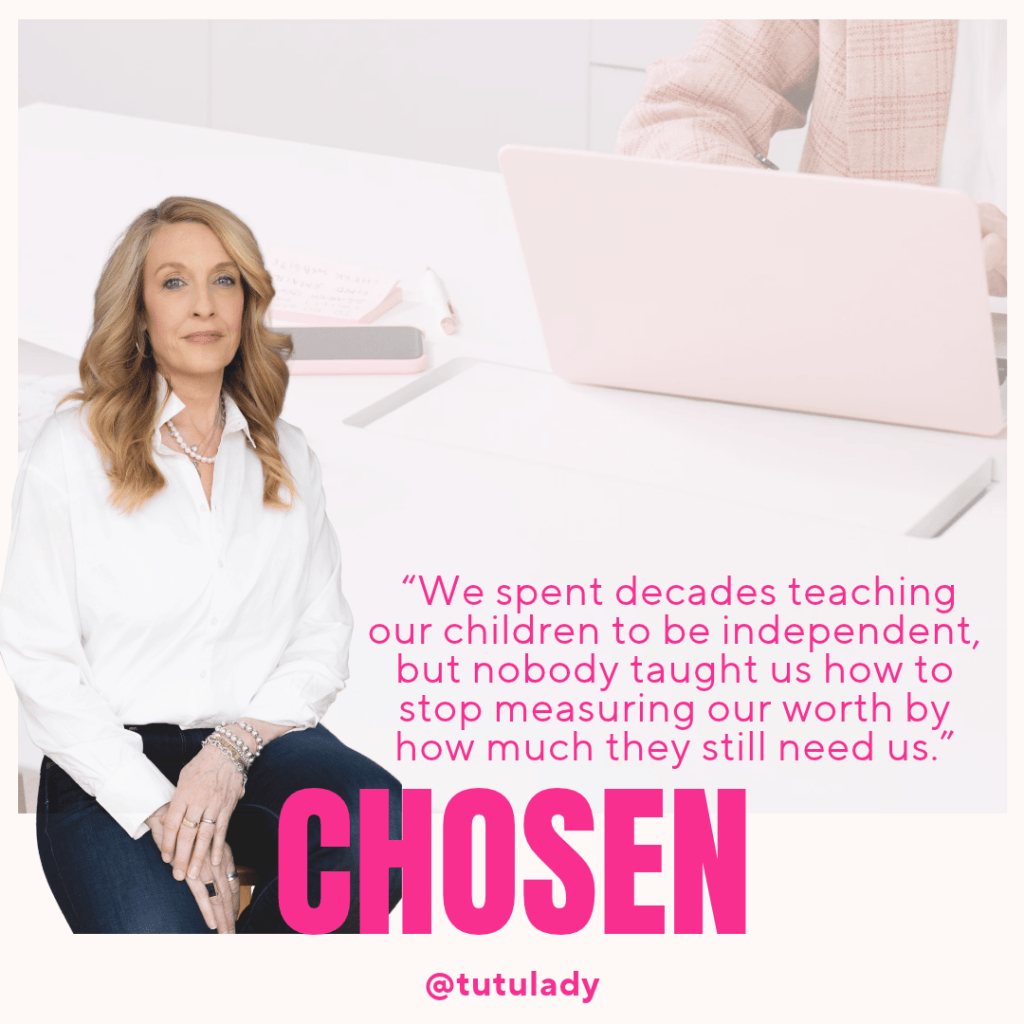
Then one day, the children grow up. They build lives, find partners, establish traditions and routines that don’t necessarily include us, and make decisions without asking our opinions. Which is exactly what we raised them to do. And we are proud. So incredibly proud. But there’s a strange grief that comes with raising independent adults. You spend years being essential to someone’s everyday life, and suddenly you’re optional. Nobody tells you how to navigate that. Nobody tells you how to stop measuring your worth by how often the phone rings, how often you get a text, whether you’re invited, or whether someone chooses to spend time with you. And nobody tells you how much it can hurt to realize that the people you would choose first every single time might not always choose you at all.
I’ve had this conversation with so many women, often in hushed tones, as though we’re confessing some terrible maternal sin. We talk about feeling left out, unappreciated, or unsure of where we fit in our adult children’s lives. We admit that sometimes we’re lonely, sometimes we’re hurt, and sometimes we’d just like someone to text or, god forbid….. make a phone call…… because they actually WANT to talk to us, not because they need the family Netflix password. And then, almost inevitably, we feel guilty for saying any of it. Because somewhere along the way, women were handed the ridiculous expectation that good mothers should be endlessly giving, endlessly available, and endlessly grateful for whatever scraps of attention come our way. We’re supposed to be thrilled that our children are independent, never mind that independence occasionally feels like we’ve been laid off from a job we worked around the clock for decades. No severance package, no retirement party, and apparently no exit interview.
And heaven forbid we admit that we want something for ourselves…. that we want to be included, appreciated, or even chosen. Somehow, wanting a life outside of motherhood is still treated as selfish, while sacrificing every bit of ourselves is practically a competitive sport. We’ve been conditioned to believe that a good mother puts herself last. And after decades of doing exactly that, we’re supposed to magically know how to put ourselves first without feeling guilty. I’d love to know who came up with this arrangement because I’d like a word.
I have spent years examining my mistakes, apologizing for things I wish I had done differently, and trying to repair relationships complicated by divorce, changing family dynamics, and the simple fact that we’re all human. I believe in accountability and growth. I believe we can acknowledge the ways we’ve hurt people without allowing those mistakes to become our entire identity. But I’m beginning to understand that there is a difference between taking responsibility for your past and spending the rest of your life apologizing and trying to earn forgiveness. There is an enormous difference between loving someone and needing their approval to feel worthy of love. And at some point, continuing to audition for a role you’ve already spent decades playing becomes exhausting.
I think that’s where I find myself these days. Trying to figure out how to be the mother of adults without losing myself in the process. Learning when to reach out and when to give space, when to offer advice and when to keep my mouth shut. (That last one remains a work in progress!) And perhaps most importantly, trying to understand that their choices are not necessarily a reflection of my worth. I can know all of this intellectually and still feel hurt when I’m not included or when my efforts seem to go unnoticed/unacknowledged. Knowing something and actually living it are two very different things. Apparently, at sixty, there are still plenty of lessons left to learn.
Because here’s the thing. There are people in my life who genuinely enjoy my company. People who invite me places, laugh at my ridiculous stories, appreciate my kindness, my humor, my occasionally inappropriate commentary, and my ability to show up with snacks, flowers, or whatever else might make someone’s day a little better. There are friends who choose me, colleagues who appreciate me, and former students who remember me. People who see the good in me without requiring a dissertation on everything I’ve ever done wrong. And yet, how often do I overlook all of that because I’m focused on the approval I haven’t received? How many wonderful moments have I diminished because I was thinking about who wasn’t there? Too many, I’m afraid.
Maybe that’s the lesson I’m supposed to be learning in this season. Not how to make people choose me, but how to stop abandoning myself while waiting for them. For nearly sixty years, I’ve been somebody’s daughter, sister, wife, mother, teacher, friend, caregiver, and problem solver. I’ve spent a lifetime making sure everyone else had what they needed, often at the expense of figuring out what I needed. And now, with my children grown, no partner and both of my parents gone, I’m finding myself in a place I never anticipated. For the first time in my adult life, there isn’t someone who depends on me in quite the same way. There is freedom in that, certainly, but there is also a loneliness that I don’t think we talk about nearly enough.
I’m learning to ask myself questions that once seemed almost selfish. What do I want to do today? Where do I want to go? What would make ME happy? Not what would make me useful, or what would make someone proud of me, or what might earn me an invitation or a little more affection. Just what would bring me joy. Maybe it’s taking a long walk with no particular destination. Maybe it’s eating exactly what I want without worrying about anyone else’s preferences. Maybe it’s spending an entire afternoon reading, needlepointing, or doing absolutely nothing productive. Imagine that. A woman who spent decades taking care of everyone else deciding that her own happiness deserves a place on the calendar. Revolutionary stuff, right?
And none of this means I love my children any less. I will always be their mother. I will always celebrate their successes, worry when life gets hard, and hope they know there’s always a safe place to land with me. But I also want relationships with them that grow because we enjoy each other, not because I am constantly trying to prove that I deserve a place. I want to know them as adults, and I want them to know me as a person, not simply as the woman who raised them. I want to laugh with them, share experiences, make new memories, and build something different from the relationships we had when they were little. And I want to leave room for those relationships to evolve, even when that evolution doesn’t happen on my timeline ……which, for the record, would probably be yesterday.
I’m beginning to realize that I can love them fiercely without chasing them. I can leave the door open without standing in the doorway waiting. I can acknowledge the hurt without making it the center of my life. And I can be proud of the mother I’ve been while still becoming the woman I want to be. Maybe that’s what this next chapter is really about. Learning that I don’t have to audition for a place in anyone’s life. Learning that being needed and being loved are not the same thing. Learning that my worth didn’t disappear when my children stopped needing me to manage their everyday lives. And learning to look at myself through the eyes of the people who already see something wonderful in me, including, eventually, my own.
I’m still figuring it out. Some days are easier than others. Some days the hurt gets the better of me, and I find myself wondering what I could do differently to be more lovable, more appreciated, more included. I can recognize that I have a full and beautiful life and still wish certain people were more present in it. Those feelings can coexist. Grief and joy have been sharing space in my life for a while now, and apparently they’re making room for a few more complicated emotions. But I’m getting better at recognizing when I’m allowing someone else’s choices to determine how I feel about myself. And I’m reminding myself that I am allowed to have a beautiful, full, joyful life even when some of the relationships I treasure aren’t what I wish they were.
Perhaps the most important thing I’m learning is that I don’t have to stop loving anyone to start loving myself. I don’t have to become harder, colder, or less available. I can remain the person who loves deeply, shows up, remembers the little things, and believes in the importance of family. But I can also extend some of that same tenderness, patience, and generosity to myself. After all, I’ve spent a lifetime teaching my children that they are worthy of love simply because of who they are. Maybe it’s time I started believing that about myself.
And maybe it’s time we stopped treating mothers who want something for themselves as though they’ve violated some sacred oath of self-sacrifice. We chose to be mothers and raise humans, we did not sign up for a lifelong obligation to erase ourselves.
So I’m returning to that question. What if I started seeing myself through the eyes of the people who appreciate me instead of the people whose approval I’ve been trying to win? What if I stopped keeping score of the invitations I didn’t receive and started appreciating the ones I did? What if I stopped wondering why someone didn’t choose me and started paying attention to all the people who do? And what if, after all these years of putting everyone else first, I finally gave myself permission to build a life that I love, regardless of who decides to be part of it?
I don’t have all the answers. But I do know that motherhood doesn’t end when our children grow up. It evolves, and so must we. Maybe this next season isn’t about doing more, trying harder, or proving our worth. Maybe it’s about trusting that the love we’ve given matters, even when it isn’t acknowledged in the ways we’d hoped. Maybe it’s about finding joy in being a mother without allowing motherhood to be the only thing that defines us. And maybe, after all these years of choosing everyone else, it’s time to choose ourselves, too. Not instead of them, but alongside them. Because wanting to be loved, appreciated, and included doesn’t make us needy. It makes us human. And wanting a life of our own doesn’t make us selfish. It makes us women who finally understand that we matter, too.
Peace,
#tutulady
#forwardisapace